
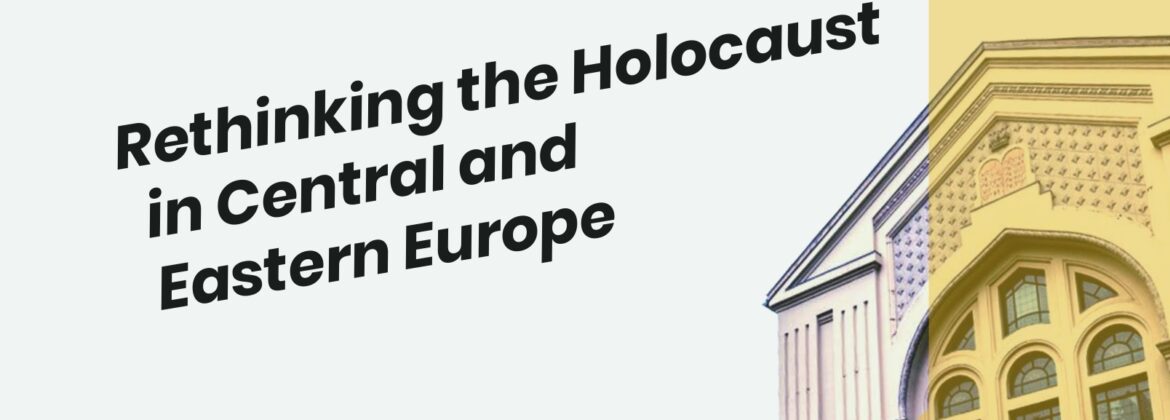
Rethinking the Holocaust in Central and Eastern Europe
International conference
Venue: Holocaust Memorial Center, Budapest
Date: 17-18 May 2027
Format: in-person
The aim of this conference is to bring together scholars researching the Holocaust in Central and Eastern Europe to explore the region’s diverse historical experiences, its regional specificities and internal differences, as well as the cross-cultural relations and transnational entanglements that shaped them. By placing local and national histories in a broader regional and comparative framework, the conference seeks to examine the region as a historically interconnected space and highlight both the distinct contexts in which persecution and mass violence unfolded and the shared questions that inform contemporary scholarship. Each panel is organized around a major thematic issue, providing a framework for invited scholars to present their research, elaborate on their analytical and methodological choices, discuss current research trends and emerging approaches, and reflect on the historiographical traditions and debates that have shaped the study of the Holocaust in their respective countries. Particular attention will be paid to the ways in which local sources, political and social contexts, and evolving research agendas shape historical interpretations. Through these discussions, the conference aims to foster dialogue across national and disciplinary boundaries, encourage methodological exchange, and identify new avenues for collaborative research on the Holocaust in Central and Eastern Europe.
Panelists will be asked to deliver a ten-minute-long presentation outlining their main points, research agendas and methodologies, followed by a roundtable discussion organized around 3-4 key questions. Panel chairs will reach out to participants in advance to discuss the main topics addressed during the roundtables.
We invite both emerging and well-established scholars to submit their proposal containing a short biographical note (200 words) and an abstract (500 words) to the e-mail: hhrn2025@gmail.com until 15 January 2027. Proposals should address one or more of the following topics:
- Victim sources and their integration into history writing
- Holocaust memory and culture in the postwar years, socialism and beyond
- The Roma Holocaust
- Holocaust in the occupied territories
- Comparative fascism and anti-fascism
- Digital humanities and the use of AI in Holocaust research
- National histories in transnational contexts
- Perpetrators, collaborators, bystanders and their roles
The organizers will try to secure funding for the reimbursement of travel and accommodation costs. Reimbursement is dependent on the outcome of these applications. Participation at the conference is free of charge.